AI Server Retirement vs. Traditional Server Retirement: 8 Critical Risks Enterprises Should Manage
Manage GPU, HBM, NVMe, BMC, SmartNIC/DPU, serial tracking, residual value, Chain of Custody and ESG risks in enterprise AI server retirement.
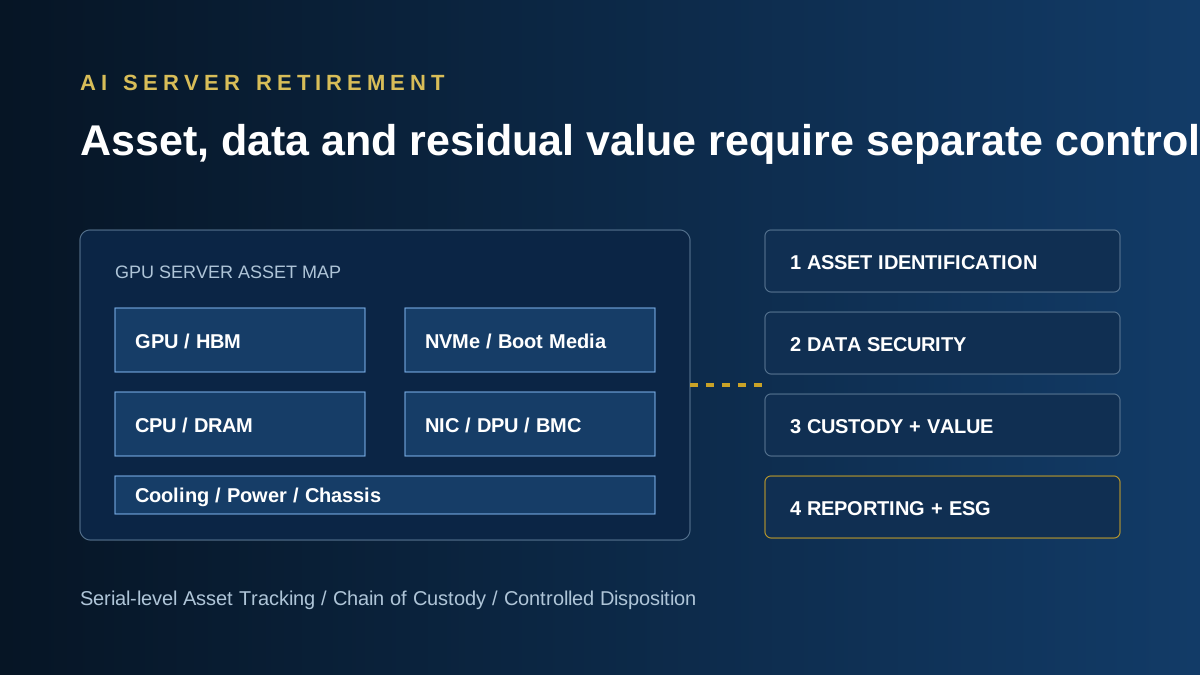
Traditional server retirement already requires data, asset and facility coordination. AI and GPU servers add high-value accelerators, dense NVMe storage, BMCs, SmartNICs or DPUs, liquid cooling and demanding power profiles. Treating the project as “remove the hard drives and move the chassis” can lose control of data, residual value and audit evidence at the same time.
AI Server Retirement is Asset Identification + Data Security + High-value Component Recovery + Chain of Custody + Residual Value Management + ESG / Circularity Reporting—not simply destroying hard drives.
Executive summary
The difference is not only the price of a GPU. Data and configuration may be distributed across NVMe, boot media, BMC, network-offload components and attached storage, while valuable components may need to remain reusable. The process should inventory the configuration at serial level and then decide whether each component will be redeployed, sanitized, separated, sold or destroyed based on data risk, ownership, condition and market context.
Traditional server vs. AI server retirement
| Dimension | Traditional server | AI / GPU server |
|---|---|---|
| High-value components | CPU, DRAM, storage, NIC | GPU, HBM, NVMe, CPU/DRAM and NIC/SmartNIC/DPU with concentrated and volatile value |
| Data locations | HDD/SSD, RAID, BMC, boot media | General locations plus dense NVMe, DPU/SmartNIC, cache or specialized modules |
| Facility conditions | Standard racks, air cooling and cabling | High power, weight, liquid cooling, dense networking and specialized racks |
| Value decision | Chassis or component reuse | Often requires component-level configuration, serial, condition and market review |
| Evidence | Asset list, media outcome, transport and closure | Also needs split/merge mapping, high-value disposition and detailed exceptions |
Risk 1: inventory stops at the chassis
An AI server may contain multiple GPUs and NVMe devices plus CPUs, DRAM, NICs or DPUs, BMC modules, power supplies and cooling hardware. If the inventory records only a chassis asset tag, the organization may be unable to explain where an individual GPU, SSD or board went after separation. Where practicable, establish parent-child asset relationships and capture serial, configuration and condition for critical components.
Risk 2: only the primary NVMe devices are treated
A BMC may retain network settings, account information or event logs. Boot media can contain images and credentials. A SmartNIC or DPU can include local storage, firmware and control-plane settings. Not every component contains persistent customer data, but the retirement team should identify and assess them rather than classify them only by appearance.
Risk 3: GPU and HBM data risk is oversimplified
HBM is generally volatile memory and should not be described as equivalent to an SSD for long-term storage after power removal. Even so, the broader GPU platform may involve firmware, diagnostic records, host images, attached storage or system state that requires control. Whether a GPU is retained, tested or destroyed should reflect platform design and customer policy. High price should not erase security review, and security concern should not automatically force destruction of every GPU.
Risk 4: Chain of Custody ends when components are separated
When a GPU, NVMe device or DPU leaves its original chassis, the inventory should be updated. Operator, time, location, container, seal, recipient and subsequent test or treatment can be recorded according to scope. A custody record that stops at chassis removal creates a gap for downstream component disposition.
Risk 5: residual value is considered before ownership and data controls
Market price does not replace proof of ownership or secure treatment. Confirm authority to dispose, lease and warranty constraints, export or contractual conditions, and data requirements before selecting reuse, redeployment, secondary market or recycling. Valuation should state configuration, tested condition, quantity, delivery timing and market assumptions; it should not be represented as a guaranteed recovery amount.
Risk 6: Data Center Decommissioning overlooks facility constraints
AI racks may be heavy and power-dense, with liquid loops, coolant, busway, fiber and high-speed interconnect. Retirement planning should coordinate shutdown authority, draining and depressurization, lockout, removal paths and floor loading with data center operations, EHS, facilities and IT. An ITAD provider should not assume authority to operate live infrastructure.
Risk 7: sanitization is reported as complete without exceptions
At scale, devices may fail to power on, remain locked, report mismatched serials or not support the planned command. These outcomes should not be rolled into “100% successful.” Define verification, validation and an exception path that redirects failed assets to an approved alternative and preserves the variance in project reporting.
Risk 8: ESG reporting provides weight without a clear boundary
Reuse, component recovery and material recycling may support circularity outcomes, but ESG figures should identify data sources, estimation methods, transport and treatment boundaries. Estimated carbon reduction benefits should be described as estimates based on available data, not as third-party assurance or a guaranteed reduction.
Recommended AI Server Retirement workflow
- Confirm ownership, shutdown authority, scope and site constraints.
- Inventory chassis and critical GPU, NVMe, NIC/DPU and related components.
- Identify data-bearing media and persistent settings or credentials.
- Approve on-site/off-site, sanitization, destruction, redeployment and recovery paths.
- Execute de-racking, packing, sealing and controlled transport.
- Validate media outcomes and manage exceptions.
- Perform high-value component recovery and residual-value disposition under agreed controls.
- Deliver Chain of Custody, serial list, Certificate of Destruction, disposition and ESG summaries.
Related services
- AI and GPU Server Retirement
- Server Retirement and Data Center Decommissioning
- Secure Data Destruction
- Discuss Your ITAD Requirements
References
This article provides a general planning framework. It does not imply that every AI server contains the same components or should follow the same treatment. Confirm the project against the bill of materials, manufacturer guidance, data policy, site and contract requirements.
Frequently asked questions
Is AI server retirement only about treating NVMe SSDs?
No. The review should also consider boot media, BMC configuration, SmartNIC or DPU components, removable modules and other elements that may retain data or credentials.
Must GPUs and HBM always be physically destroyed?
Not necessarily. Data persistence, device condition, customer policy and reuse conditions should be reviewed. Data risk and asset value should be assessed separately.
How should GPU residual value be handled in ITAD?
After ownership, serials, configuration, condition, data treatment and market conditions are confirmed, assets can be assessed for redeployment, spares, secondary-market disposition or material recovery.
Plan the next step with KYI
Discuss your IT asset retirement or secure data destruction requirements with KYI.
Contact KYI →