Degaussing vs. Data Erasure vs. Physical Destruction: How Should Enterprises Choose?
Compare HDD degaussing, data erasure and physical destruction by media type, reuse potential, validation evidence and risk to build an auditable destruction decision.
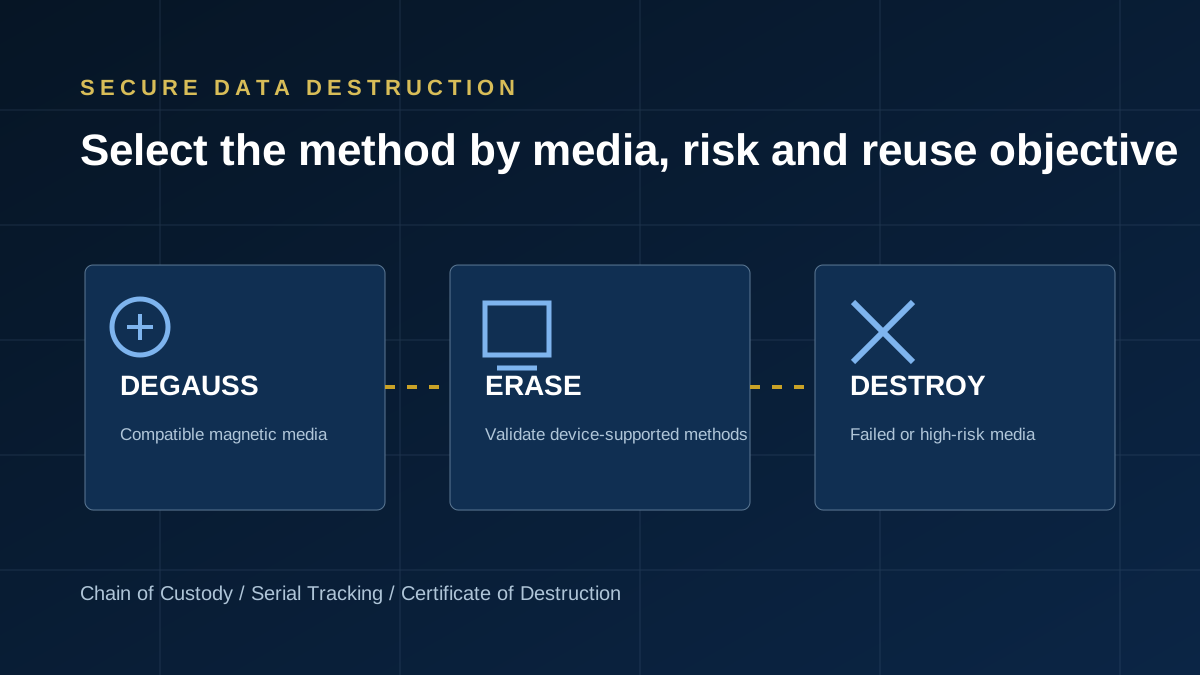
Enterprises often use degaussing, data erasure and physical destruction as if they were interchangeable. They are not. Each acts on different media, has a different effect on residual asset value and produces different evidence. The right question is not which method looks most dramatic. It is: given the media, data sensitivity, device condition and intended disposition, which method makes access to the target data infeasible at an acceptable level of effort—and how will the organization verify that outcome?
Executive summary
- Data erasure uses a media-supported command or controlled overwrite process. It may preserve reusable value, but completion and exceptions must be validated.
- Degaussing exposes compatible magnetic media to an adequate magnetic field. It applies to magnetic HDDs and tape, not SSD, NVMe, USB or other NAND flash.
- Physical destruction damages the data-bearing medium or memory component. It is commonly selected for failed media, higher-risk data or assets that will not be reused.
NIST SP 800-88 Rev.2 frames media sanitization as an organizational program. Method selection, execution, verification, validation, exception handling, documentation and service-provider oversight are connected controls.
Comparison table
| Method | Typical media | Reuse potential | Primary limitation | Evidence to retain |
|---|---|---|---|---|
| Data erasure | Responsive HDD, SSD or NVMe supporting an approved method | Often yes | The method must match the media and reach the intended storage scope | Serial number, tool/version, method, completion status, validation result |
| Degaussing | Compatible magnetic HDD and tape | Normally no | Field strength must be suitable; it does not work on NAND flash | Media identity, degausser model, operation record and equipment status |
| Physical destruction | Failed, high-risk or non-reusable media | No | Destruction method and particle outcome must reflect media construction and risk | Counts, serials, method, witness/photo evidence and exceptions |
Data erasure: preserve value only when the result can be validated
Erasure can return functioning assets to redeployment, spares or value-recovery workflows. For a conventional HDD, an approved overwrite process may form part of a Clear method. For SSD and NVMe, organizations should review device-supported Secure Erase, Sanitize or Cryptographic Erase capabilities rather than assume that repeated host-level overwriting reaches all physical NAND locations.
Three controls matter. The device must be correctly identified. The command must apply to the actual media and configuration. Completion—not merely command acceptance—must be checked, with errors and exceptions reconciled against the serial-level inventory. A tool screen showing “success” without asset identity and review context is weak audit evidence.
Degaussing: a magnetic-media method, not a universal eraser
Degaussing changes the magnetic state used to record data. Effectiveness depends on the media characteristics, field capability, procedure and equipment condition. NAND flash is not magnetic storage, so degaussing is not a valid SSD or NVMe sanitization method.
For HDD projects, failure to boot after degaussing is not the only required evidence. Records should connect the asset to the equipment used, operation time, responsible operator and any abnormal result. On-site projects should also separate untreated and treated media physically so that custody and counts remain reliable.
Physical destruction: visible damage is not automatically sufficient
The effectiveness of destruction depends on media construction, the process, resulting particle size and downstream control. Damaging an SSD enclosure does not necessarily address every NAND package. For magnetic HDDs, simple platter deformation may stop ordinary operation, while a higher-security policy may require degaussing followed by deformation or disintegration.
The organization should define the risk model first: information sensitivity, whether media will leave controlled custody, whether reuse value should be preserved, what validation is expected, and whether a contract or regulator imposes additional conditions.
The different roles of NIST SP 800-88 and NSA EPLs
NIST SP 800-88 Rev.2 is guidance for establishing a media sanitization program. It is not a service-provider certification and does not guarantee that a specific project is compliant.
NSA Evaluated Products Lists identify equipment models evaluated against NSA/CSS specifications, principally for NSA/CSS and US classified-media use. NSA states that its lists concern equipment—not approval of on-site destruction vendors—and that listing is not an NSA or US Government endorsement. Commercial organizations may use an EPL as high-security equipment research, but should not present it as the only valid answer for every business record or as certification of a provider.
Five steps to an auditable decision
- Identify the media: distinguish HDD, SSD, NVMe, tape and embedded memory.
- Classify data and assets: record sensitivity, condition, reuse objective and custody risk.
- Approve the method: document the chosen Clear, Purge or Destroy path and rationale.
- Validate and manage exceptions: separate completed, failed, unidentified and redirected assets.
- Complete the Chain of Custody: reconcile receipt, transport, storage, treatment and the Certificate of Destruction.
Related services
- Secure Data Destruction
- HDD Data Destruction
- SSD and NVMe Data Destruction
- Discuss your ITAD requirements
References
This article summarizes public standards and technical information. It is not legal advice, certification, or a project-specific compliance conclusion. Confirm the method against the media, data, customer policy, contract and applicable requirements.
Frequently asked questions
Can an HDD be reused after degaussing?
Generally, reuse should not be expected. Effective degaussing affects magnetic data and drive service information, so the device normally has no predictable reuse path; the actual outcome still depends on the media and equipment.
Is data erasure always safer than physical destruction?
No single method is best in every case. Erasure can preserve value but requires responsive media, an applicable method and validation. Failed or high-risk media may require physical destruction.
Does use of NSA EPL equipment mean a service provider is NSA certified?
No. NSA EPLs evaluate specific equipment models against stated requirements. NSA expressly distinguishes equipment evaluation from approval or endorsement of a destruction service provider.
Plan the next step with KYI
Discuss your IT asset retirement or secure data destruction requirements with KYI.
Contact KYI →