Why SSD and NVMe Require Different Data Destruction Methods from HDDs
Understand how NAND flash, wear leveling, over-provisioning and NVMe Sanitize affect SSD data destruction, cryptographic erase, physical destruction and validation.
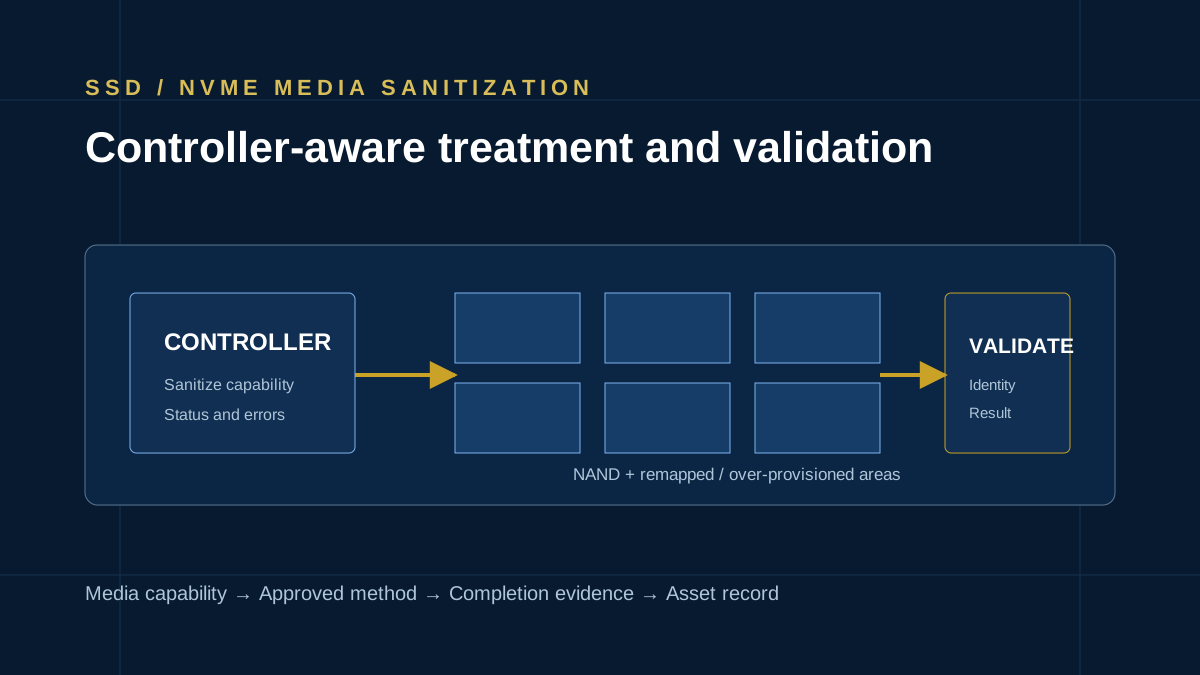
HDDs and SSDs both store enterprise data, but their internal architectures are fundamentally different. An HDD records magnetically on rotating platters. An SSD or NVMe device uses a controller to manage NAND flash. That difference changes sanitization coverage, validation and failure modes.
Applying a conventional HDD overwrite workflow unchanged to an SSD can produce a reassuring tool message without enough evidence about the physical media. The important question is not how many overwrite passes were requested. It is whether the selected device-supported method covers the target data and whether completion can be validated.
Executive summary
- NAND flash is not magnetic media; degaussing does not sanitize SSD or NVMe.
- Wear leveling maps repeated writes to changing physical locations.
- Over-provisioned and remapped locations are not normally exposed as host-addressable blocks.
- Evaluate supported Secure Erase, Sanitize, Block Erase or Cryptographic Erase capabilities and monitor completion status.
- Failed, unsupported or higher-risk media may require physical destruction and controlled downstream treatment.
Logical addresses are not physical NAND locations
The Flash Translation Layer maps logical block addresses to physical NAND pages and blocks. Wear leveling distributes writes, garbage collection moves valid data, and bad-block management retires unreliable locations. Additional capacity may be reserved as over-provisioning to support endurance, performance and replacement of worn blocks.
A host application that overwrites every visible logical address therefore cannot, by that fact alone, demonstrate treatment of every historical physical location. This does not make all software-based erasure invalid. It means the method should invoke and verify relevant device capabilities rather than depend only on file-system operations.
SSD and NVMe method comparison
| Method | Prerequisite | Benefit | What must be checked |
|---|---|---|---|
| ATA Secure Erase / Sanitize | Device explicitly supports the command and remains responsive | Controller-level operation | Capability, security state, completion and error result |
| NVMe Sanitize | Controller reports the relevant Sanitize Action | Designed to address user data across the NVM subsystem | Sanitize is asynchronous; command acceptance is not operation completion |
| Cryptographic Erase | Data was strongly encrypted from the start and every relevant key can be removed | Fast and potentially preserves reuse value | Encryption history, algorithm, key scope and verifiable key removal |
| Physical destruction | Failed, higher-risk or non-reusable media | Does not depend on successful firmware execution | The process must address NAND components, not merely the enclosure or connector |
NVMe Sanitize requires status monitoring
NVMe defines actions including Block Erase, Crypto Erase and Overwrite, subject to controller capability. A Sanitize operation normally runs in the background. Completion of the command submission does not mean sanitization itself is complete. The workflow should monitor the Sanitize Status Log for progress, successful completion or failure mode and connect that evidence to the device serial number.
Devices in one batch may differ by firmware, capacity and capability. A project should not infer support solely from a family name or promise one method before the device state is confirmed.
Four conditions for Cryptographic Erase
Cryptographic Erase removes or replaces a key so that existing ciphertext cannot reasonably be decrypted. An enterprise approval should confirm that:
- sensitive data was encrypted before being written to the media;
- the algorithm, key strength and random source meet organizational requirements;
- no unmanaged key copy, wrapped key or external key remains available; and
- the key-removal outcome and device response can be validated and retained.
Where encryption history or key management is unknown, Cryptographic Erase should not be treated as an automatic shortcut.
Physical destruction must address data-bearing components
An SSD enclosure, PCB, controller and NAND packages are separate elements. A broken connector or damaged enclosure proves that ordinary operation is impaired; it does not automatically establish that recovery is infeasible under the selected risk model. The destruction plan should define component identification, treatment, required physical outcome and downstream material control.
Enterprise validation checklist
- Record manufacturer, model, serial number, interface and capacity.
- Read declared sanitize capabilities instead of assuming support.
- Retain tool/version, method, start time, completion status and errors.
- Create an exception path for unidentified, locked or failed devices.
- Perform validation against information classification and policy.
- Connect outcomes to the Chain of Custody, serial list and Certificate of Destruction.
Related services
- SSD and NVMe Data Destruction
- Secure Data Destruction
- Server Retirement
- Request a secure data destruction consultation
References
- NIST SP 800-88 Rev.2 — Guidelines for Media Sanitization
- NVM Express Base Specification 2.0e — Sanitize Operation Considerations
- NVM Express — Securely erasing data on an NVMe SSD
This article provides general technical and risk-management information. It does not guarantee that a particular device supports a command. Confirm the method against manufacturer documentation, device response, information sensitivity and customer policy.
Frequently asked questions
Can an SSD be sanitized by degaussing?
No. SSD and NVMe devices use NAND flash rather than magnetic storage, so an HDD degaussing process is not an effective SSD sanitization method.
Are multiple overwrite passes safer for an SSD?
Not necessarily. Host overwrites are affected by wear leveling, remapped blocks and over-provisioning. More passes do not prove that every physical location was addressed and may add unnecessary write wear.
When is Cryptographic Erase credible?
The organization should confirm that data was strongly encrypted from the start, key scope is understood, every relevant key can be reliably removed, and the result can be validated and recorded.
Plan the next step with KYI
Discuss your IT asset retirement or secure data destruction requirements with KYI.
Contact KYI →